• AI / Product / LLM
Ballistic missiles, Yad2 apartments, and agentic interfaces
What counts as a real agentic workflow is not a multi-step LLM with seventeen tools. It is a natural-language interface over a dataset someone actually needs to query. The example: alarms data + Yad2 rentals + Mamad s...
TL;DR — A useful agentic workflow can be as simple as putting a chat interface over the right joined dataset. Combine alarm history, Yad2 rentals, and Mamad (saferoom) data, then let people ask: “show me apartments for rent in southern Israel, with a saferoom, in places with fewer alarms.” That is a real agentic interface.
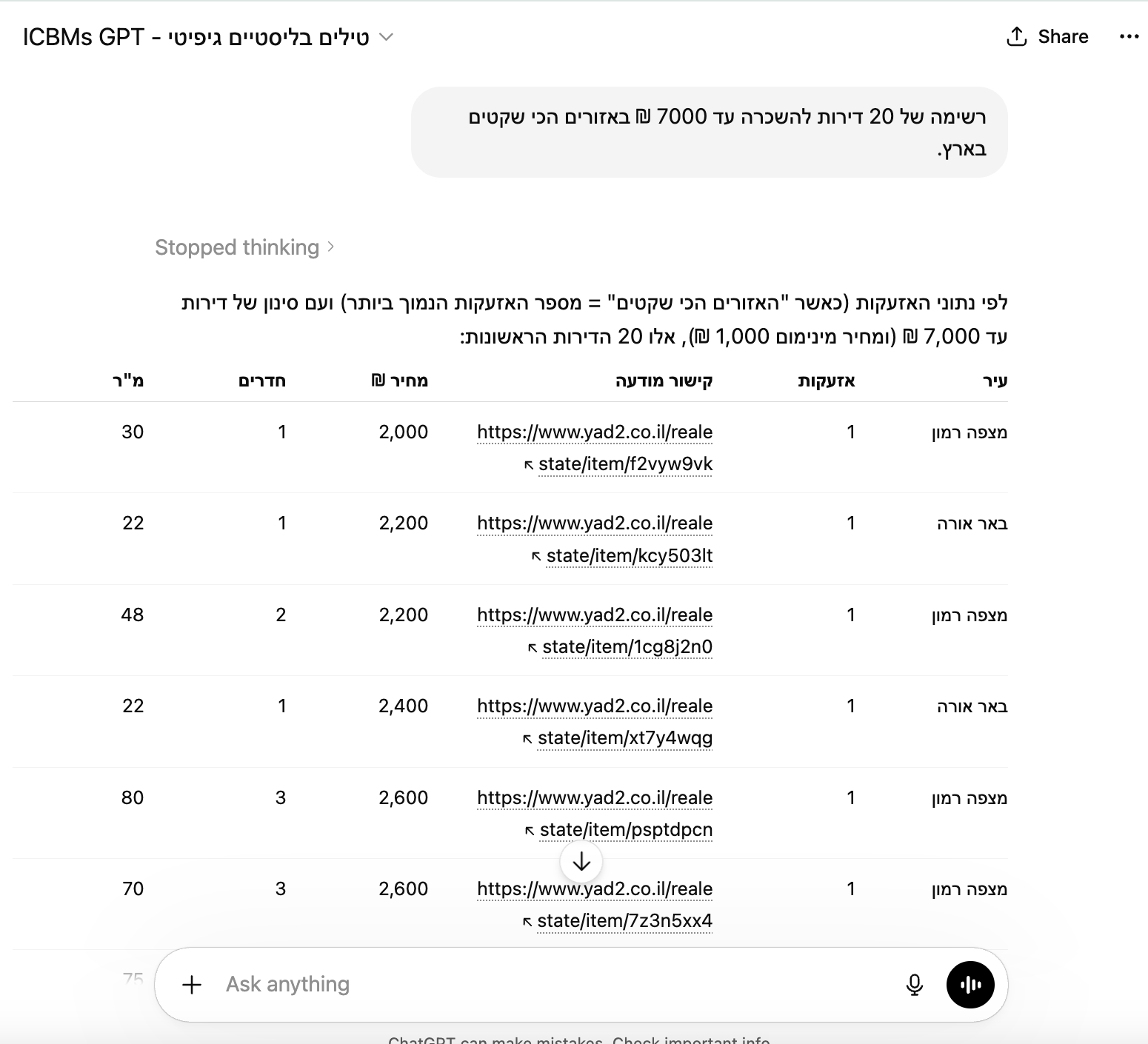
Try it yourself: ICBMs GPT — טילים בליסטיים גיפיטי
What “agentic” means in practice
The industry calls a lot of things agentic. Multi-step LLMs with tools. Self-orchestrating workflows. ReAct loops. CodeAct. Anything with a planner module.
But for an end user, “agentic” can mean something much simpler: a natural-language interface over a dataset they could not query before. No SQL. No clicking through eight filters on a real-estate listing site. No cross-referencing three open tabs.
The framing problem isn’t the LLM. The framing problem is the dataset.
The Israel housing example
Take three public-ish datasets that exist today:
- Real-time alarm data for Israel — historical and live, by region and time of day.
- Yad2 — the dominant Israeli classifieds site for rentals.
- Mamad data — which apartments have a saferoom, by building or street.
Individually each is a SQL table or a scraping target. Combined, in natural language, they become:
“Show me 3-bedroom apartments under ₪7,500 in the south with a saferoom, in cities with fewer than 5 alarms per month over the last year.”
That query is not available in a normal real-estate UI. It requires:
- Geographic filtering (south of Israel)
- Cross-reference of alarm counts per municipality
- Time-window aggregation (per-month, last 12 months)
- Two-column join (alarms × listings × mamad)
A chat interface over an LLM with these three datasets as context, retrieval, or tool calls collapses 30 minutes of cross-referencing into 30 seconds. That is the agentic workflow.
Why this is “headless”
The interesting design decision is what the agent isn’t doing.
- It’s not building a custom UI per query.
- It’s not generating a dashboard.
- It’s not running a complex planner.
It’s exposing one input box, one output. The “agent” is the dataset wiring + a chat completion. The orchestration is hidden — that’s the headless part.
This is the form factor that scales. Every dataset that someone cares about deserves a chat interface like this.
What the missile week clarified
The original framing — what got me thinking about this — is that during the same week ballistic missiles were flying overhead, people were still trying to rent apartments. The cognitive load of “is this safe to live in?” is a real, recurring query. No real-estate site answers it. No government site answers it. A small chat interface over public data could.
That generalises:
- Crime + housing for any city.
- Air quality + schools in any country with sensor data.
- Inspections + restaurants in cities with public health-code data.
- CVE feeds + your S3 buckets for security.
The pattern is always the same: a domain expert knows what query they want to ask, the datasets exist, no UI exposes both at once. An LLM + a chat box closes the gap.
What an MVP looks like
- One landing page.
- One chat input.
- Three datasets in the system prompt (or as retrieval tools).
- One model — GPT-class is fine.
- No accounts. No auth. No persistence beyond a session.
That is a real agentic product. Not a planner. Not a multi-tool ReAct loop. A chat interface over a dataset that someone could not previously query.
The rest is just sales.